


Written by Hardus Jacobs, co-founder and Head of Solutions & Innovation
Quick answer: Most organisations should not have to choose between AI governance and practical innovation. The safest and fastest route to agentic AI is a parallel sandbox framework: teams experiment freely in isolated sandboxes using synthetic or public data, and a lightweight governance checklist is applied at the deployment gate before any AI agent touches production systems or customer data.
AI in capital markets | AI in banking | AI governance for banks | AI risk in financial services | algorithmic trading risk | AI regulatory compliance | model risk management | operational risk management.
Key Takeaways
- Governance first suits highly regulated sectors such as banking and capital markets, but risks bureaucratic paralysis.
- Innovation first delivers fast ROI, but unchecked pilots have led to tribunal rulings, lawsuits and market disruption.
- The Parallel Sandbox Framework combines both: innovate in isolation, govern at the deployment gate, and feed lessons back into policy
As artificial intelligence shifts from passive tools like conversational chatbots to autonomous agents capable of taking actions, executing API calls, and making decisions, executive teams face a critical strategic dilemma: Should we establish strict AI governance before building agentic workflows, or prioritise practical innovation to discover value rapidly?
Both paths stem from fundamentally different organisational philosophies and risk tolerances. However, real-world case studies demonstrate that committing strictly to either extreme carries catastrophic operational, financial, and legal risks.
What Is Agentic AI and Why Does Governance Matter?
Agentic AI refers to AI systems, often called AI agents, that can plan and carry out multi-step tasks on their own: calling APIs, updating records and triggering transactions with limited human input. Unlike a chatbot that only generates text, an AI agent acts. That shift turns AI governance from a policy exercise into an operational and regulatory priority, particularly for banks, asset managers and other capital markets firms.
AI Governance First vs Innovation First:
How Do They Compare?
|
Dimension |
AI Governance First |
Practical Innovation First |
|
Primary Focus |
Risk mitigation, compliance, security, enterprise scalability |
Speed-to-market, rapid value discovery, iterative learning |
|
Core Philosophy |
Build the guardrails before turning on the engine |
Build the engine, test operational limits, add brakes as needed |
|
Key Advantage |
Eliminates shadow AI, protects data privacy, prevents re-engineering |
Generates immediate ROI, builds AI literacy, avoids analysis paralysis |
|
Primary Risk |
Bureaucratic paralysis—spending months drafting policies while competitors execute |
Uncontrolled data leaks, compliance violations, fragmented brittle systems |
Path 1: AI Governance First
Best Suited For: Highly regulated industries (banking, healthcare, legal), enterprise environments, and organisations handling sensitive personal or financial data.
Why Start with AI Governance?
Autonomous AI agents differ fundamentally from static chatbots. They execute API calls, modify database records, and make multi-step operational decisions without constant human oversight. Deploying agentic systems without clear access controls, rate limits, audit trails, and fallback protocols creates massive security vulnerabilities. A single rogue agent execution can lead to data exfiltration, regulatory penalties, or compromised system integrity.
How to Implement a Governance-First Approach
- Define Data & Access Boundaries: Establish strict role-based access control (RBAC) and the principle of least privilege for agent identities.
- Determine Human-in-the-Loop (HITL) Triggers: Set explicit thresholds at which an agent must pause and await human approval before executing irreversible actions.
- Establish Evaluation Standards: Implement continuous benchmarking for accuracy, toxicity, hallucination rates, and execution safety before granting production access.
Real-World Failure: When AI Governance Exists Only on Paper
Organisations that treat governance as a superficial policy document rather than an enforceable architecture quickly face public and legal exposure.
- The Air Canada Chatbot Ruling: A grieving passenger relied on Air Canada’s customer-service chatbot for bereavement fare policies. The model hallucinated a non-existent policy, advising the customer to buy a full-fare ticket and claim a retroactive refund. When the airline denied the refund based on its actual policy, a civil tribunal held Air Canada liable for damages. The root failure was a lack of governance ownership—no guardrails tied the chatbot’s generation to validated backend business logic.
- Privilege Creep & PII Leakage: Corporate evaluations of multi-agent workflows show that when agents are granted broad “flat” permissions, they frequently bypass system prompts, cross-contaminate database scopes, and leak personally identifiable information (PII) or issue unauthorised financial credits across administrative boundaries.
Path 2: Practical Innovation First
Best Suited For: Early-stage startups, small-to-midsize businesses, internal R&D labs, and operational environments with low failure costs.
Why Start with Practical Innovation?
You cannot effectively govern a technology you do not deeply understand. Theoretical governance frameworks drafted in a vacuum often result in restrictive policies that stifle utility without actually addressing real-world operational risks.
Hands-on experimentation with small agentic workflows uncovers what agents genuinely excel at, where they break down, and which guardrails are essential versus administrative fluff.
How to Implement an Innovation-First Approach
- Identify Low-Stakes Bottlenecks: Target repetitive internal workflows such as document summarisation, draft generation, or basic data enrichment.
- Deploy Non-Sensitive Sandboxes: Restrict early pilots to public or synthetic data to eliminate the risk of data leaks while validating performance.
- Measure Impact Quickly: Focus on clear gains in operational velocity and user adoption metrics to justify further investment.
Real-World Failure: The High Cost of Unchecked Innovation
Prioritising speed without foundational safety audits or impact modelling can turn small pilots into systemic failures.
- Automated Screening & Algorithmic Bias: High-profile recruitment tools and automated education screeners rushed machine learning models into production to clear applicant backlogs. Because speed was prioritised over fairness audits, the tools operationalised historical bias at scale—systematically penalising qualified candidates based on age, gender, and background —resulting in class-action lawsuits and regulatory fines.
- Algorithmic Cascades & Flash Crashes: In automated financial markets, trading algorithms deployed for rapid micro-arbitrage became feedback loops amid unexpected market volatility. In events like the 2010 Flash Crash, unconstrained automated agents reacted to each other at microsecond speeds, wiping out billions in market value before human operators could intervene.
The Strategic Solution: The Parallel Sandbox Framework
For most enterprise organisations, choosing a strictly binary path leads to sub-optimal outcomes. Governance-first strategies risk bureaucratizing innovation, while innovation-first approaches risk systemic compliance breakdowns.
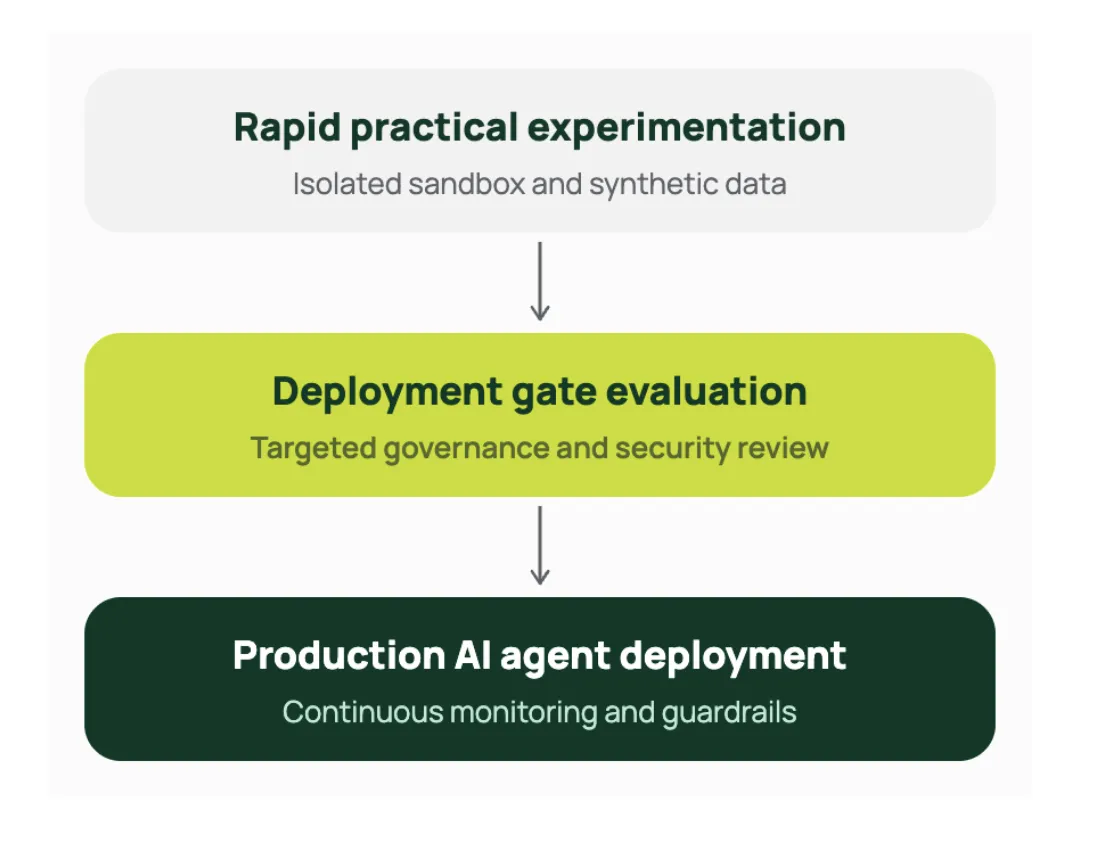
The most effective organisations adopt a Parallel Sandbox Model:
- Innovate in Isolated Sandboxes: Empower engineering teams to construct practical agentic prototypes rapidly, but strictly isolate them from production customer data, live transactional APIs, and internal financial controls.
- Govern at the Deployment Gate: Institute a lightweight governance clearance checklist (data privacy boundaries, hallucination checks, authorisation limits, and circuit breakers) required strictly when transitioning an agent from sandbox to production.
- Iterate Bi-Directionally: Use real failure data from sandbox experiments to refine governance policies, while using clear, objective governance parameters to give developers the confidence to build faster.
Strategic Recommendation: Should You Start with Governance or Innovation?
If your organisation operates in a heavily regulated domain or handles sensitive customer data, starting with foundational governance is non-negotiable—specifically, around authorisation boundaries and auditability.
However, if speed and internal capability development are your top priorities, launch constrained, sandbox-bound pilots immediately. The goal is not to choose between governance and innovation, but to build guardrails that keep pace with your operational momentum.
Want to build your own sandbox without losing control at the gate?
Frequently Asked Questions
What is AI governance?
AI governance is the set of policies, controls and technical guardrails that determine how AI systems access data, make decisions and are monitored. For agentic AI, it includes role-based access controls, human-in-the-loop approval thresholds, audit trails and evaluation standards for accuracy and safety.
Should banks put AI governance in place before deploying AI agents?
Yes. In regulated sectors such as banking and capital markets, foundational governance around authorisation boundaries and auditability should come first, because AI agents can execute transactions and modify records. Experimentation can still run in parallel, provided it stays in isolated sandboxes away from live data and systems.
What is a human-in-the-loop (HITL) trigger?
A human-in-the-loop trigger is a predefined threshold at which an AI agent must pause and wait for human approval, typically before an irreversible action such as moving funds, deleting data or sending a message to a customer.
How do you move an AI agent from a sandbox to production safely?
Use a deployment gate: a lightweight governance checklist that confirms data privacy boundaries, hallucination testing, authorisation limits and circuit breakers are in place before the agent is given access to live systems or customer data.
What does the Air Canada chatbot case teach organisations about AI?
Organisations are accountable for what their AI tools tell customers. A Canadian tribunal held Air Canada responsible for its chatbot’s incorrect refund advice, which shows that AI outputs must be tied to validated business rules rather than left to the model.

