


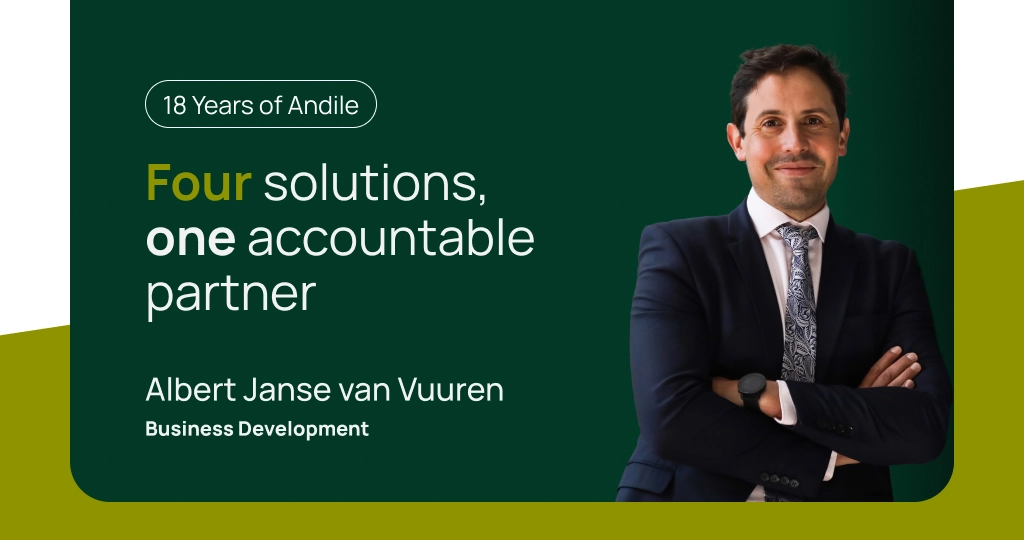
Written by Albert Janse van Vuuren, co-founder and Head of Business Development at Andile Solutions
In short:
Andile Solutions is a capital markets technology consultancy, founded in Johannesburg in 2008, that implements, runs and supports trading, treasury and risk platforms for banks. For 18 years, regulations such as Basel III, FRTB and the JIBAR transition set the agenda for these systems. The next 18 will be set by technology, especially AI. Andile meets that shift with four solutions and one accountable partner: Platform Solutions, Managed Services, Specialist Expertise and Advisory.
How did Andile Solutions Start?
Andile turned 18 on 1 October. In 2008 five of us walked into the dealing room of a large capital markets bank in Johannesburg, and we did not walk in with a project. The bank needed a team that understood both the business and the systems in a market that was moving quickly, and we were handed whatever needed solving, from a reconciliation that had to be exactly right to complex programmes that needed the correct skills behind them. We did not have an office or infrastructure of our own, and we did not need one, because the work was at the client and that is where we wanted to be. We would have slept on the boardroom table if that was what it took, because we were building a company together and we were building it for the people who had trusted us.
Within those first few years we bought iPhones for all five of us. We wanted the bank to see a small firm at the front of what technology could do while still being people you could rely on, and that mix has been our DNA ever since. We have called ourselves conservative rebels and, on better days, honourable pirates: willing to think differently and go further than the brief, and careful about how we do it. The phone also turned out to be a fair picture of what was coming. Having one was a statement back then, and today everyone’s bank runs through one.
What I only see clearly now is that we started a company in the middle of a global financial crisis and were oblivious to it. It could have been a weakness, and in practice it carried us, because the crisis did not ask for our opinion and neither did what followed.
How has regulation shaped capital markets technology since 2008?
For the next 18 years the agenda for every capital markets system we worked on was set by regulators. Basel III rewrote capital and liquidity, Dodd-Frank and EMIR moved OTC derivatives into clearing and reporting, and South Africa’s Financial Markets Act brought the same discipline home. MiFID II changed how trades were reported and how best execution was proven, IFRS 9 pulled expected credit losses into the books, and FRTB redrew the line between the trading and banking books and with it the way market risk capital is calculated. Then the benchmark rates themselves were replaced, LIBOR first and JIBAR last, with its final publication on 31 December this year, while Basel IV worked its way through the capital stack. Not one of those changes was on a bank’s own timetable, and every one of them landed inside the systems where trades, positions and risk are kept.
What does accountability mean in capital markets technology?
That is also where accountability gets tested. When a settlement fails or a risk number moves overnight, a bank does not want to hear who owns the product and who owns the project; it wants someone who stays with the problem until it is fixed. We have made mistakes across 18 years, and the difference between a mistake and a learning is whether you own it and change what you do. Through one regulatory deadline after another, the reason banks have kept working with us is that we have tried to be the ones who stay. It has meant telling a bank early when a piece of work needed more depth than we had on the team at the time, rather than letting them discover it in testing, and building a documentation habit into a client’s platform team so that the knowledge of their own system stays with them. Mostly it has meant being in the room when something goes wrong, rather than on the other end of a change request.
How is AI being used in capital markets technology today?
I do not think the next 18 years will look like the last. The rulebook written after the crisis is largely in place now, and from here the pace will be set by technology, and in particular by AI. There is a lot of noise about it, so here is the picture from our own delivery. AI is already useful in unglamorous places: building and running regression tests for an upgrade, writing and maintaining documentation, watching a platform for the patterns that come before an incident, and sorting support queries so the urgent ones reach the right person first. The platform vendors have started to put agents inside the systems of record themselves, with people approving the work at defined points. Where it is still mostly talked about is the idea of an agent acting on a bank’s books with nobody signing off. When the Bank of England and the FCA surveyed UK financial firms in 2024, only 2% of AI use cases were fully autonomous.
The phone is a useful way to think about it, because in 2008 a phone with no keyboard looked like a toy next to a BlackBerry, and within a few years everything ran through it. AI will go the same way inside capital markets, and when it does, the question of who answers for a failed settlement or a wrong risk number does not go away, it gets sharper. When an agent proposes a fix for a reconciliation break and someone approves it, that person has to understand both the agent and the platform well enough to know the fix is right, and the bank still answers to its regulator for the result. The more of the work that moves to agents, the more a bank needs a partner who understands the platform, the agents and the business well enough to stand behind the outcome.
What are Andile’s four solutions?
So how do you stay accountable to a bank over the long run? We have organised Andile around four solutions, and they replace the Run, Change and Transform language we used for years, which described how we planned our own work rather than what a bank gets:
- Platform Solutions is the platform itself, a trading, treasury or risk system implemented, upgraded and connected by people who have done it many times before. That work rests on two partnerships that are core to our business: Nasdaq, where we have worked on Nasdaq Calypso since 2012 and are a certified implementation partner, and FinMechanics, where we are the strategic partner and co-creator in Africa and take the prime role ourselves.
- Managed Services means we run your platform for you, increasingly in the cloud, with service levels you can measure, so your own team can focus on the business rather than on keeping the system up.
- Specialist Expertise puts the rare people who understand both the desk and the system inside your team for as long as you need them, and leaves your own people stronger when they move on.
- Advisory gives you an honest view before the money is spent, whether that is a review of your treasury architecture or how you govern AI before it touches trade data.
The four are one commitment organised four ways: a bank can come in through any of them, for a single upgrade or a relationship that runs for a decade, and find the same people answering for the outcome.
What comes next for trading, treasury and risk platforms?
I expect more of these platforms to move into the cloud over the next few years, not everywhere and not at the same pace, because regulators and data rules differ from market to market, but the direction is set: banks owning their data and their decisions while the software is run for them, and agents moving from answering questions to doing real work inside the systems. Through all of it the scarce thing will be people who can govern what runs on a trading platform and explain it to a risk committee, which is why we put so much into our graduate programme, our internships and our work with universities. It is slow work, and I think it is the most useful thing we do for the banks we work with.
What we ask clients to hold us to
Eighteen years ago five people walked into a dealing room and were trusted with problems that mattered. We are a bigger firm now, in more markets, and we want to be the partner banks call about what is next, not only about what has broken. The pace of this work is already being challenged, and it will change more in the next few years than it did in the last 18, because the tools that write, test and watch these systems are not the tools we started with. So we ask our clients and our own people to hold us to two things. The first is that we see what is coming and tell you straight what it means for your platforms and your people. The second is that we build what matters at the speed the market now expects, and that it is speed you can defend to your regulator, with us standing behind it long after go-live. If you think we are falling short on either, I would rather hear it from you directly.
Frequently asked questions
What does Andile Solutions do?
Andile Solutions is a Johannesburg-based capital markets technology consultancy. Since 2008 it has helped banks implement, upgrade, run and govern their trading, treasury and risk platforms through four solutions: Platform Solutions, Managed Services, Specialist Expertise and Advisory.
What are Andile’s four solutions?
Platform Solutions implements, upgrades and connects trading, treasury and risk systems. Managed Services runs your platform for you, increasingly in the cloud, with measurable service levels. Specialist Expertise places people who understand both the desk and the system inside your team. Advisory gives an independent view before you spend, from treasury architecture to AI governance.
Is Andile Solutions a Nasdaq Calypso partner?
Yes. Andile has worked on Nasdaq Calypso since 2012 and is a certified implementation partner. It is also the strategic partner and co-creator for FinMechanics in Africa.
How is AI used in capital markets technology today?
Mostly in practical, supervised work: building and running regression tests for upgrades, writing and maintaining documentation, monitoring platforms for patterns that come before incidents, and triaging support queries. Fully autonomous AI is still rare. In a 2024 Bank of England and FCA survey, only 2% of AI use cases in UK financial firms were fully autonomous.
When does JIBAR end?
The Johannesburg Interbank Average Rate (JIBAR) is due to be published for the last time on 31 December 2026, as South Africa moves to ZARONIA, the South African Rand Overnight Index Average. Banks need their trading, treasury and risk systems ready for the switch.

